Sand Tray Therapy
Central Coast NSW
Sand Tray Therapy I Rivendell Psychology
A different way of understanding what is happening beneath the surface
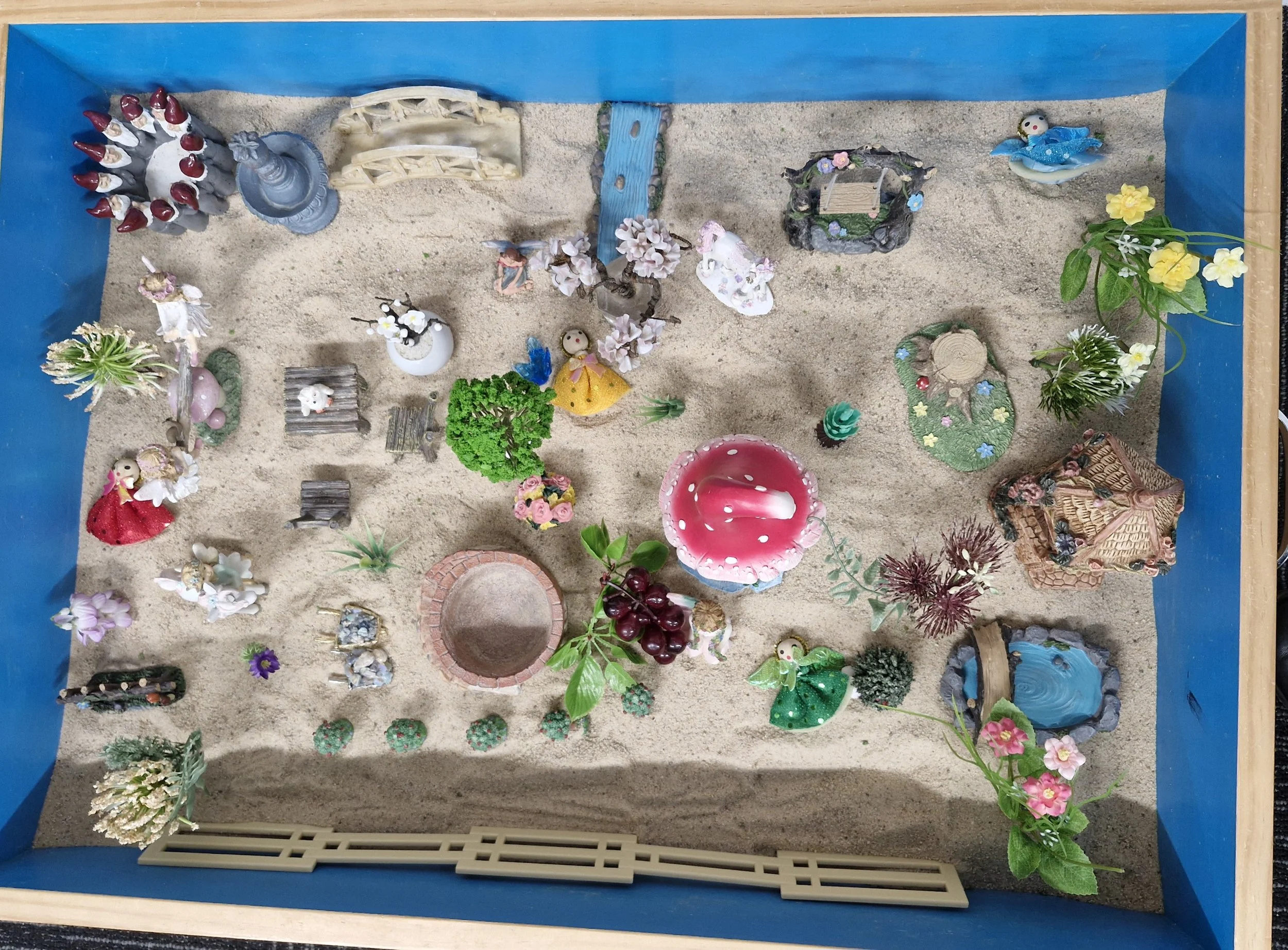
Healing the Psyche Non-Verbally
Sometimes it is difficult to put an experience into words.
This can be particularly true for children and adolescents, but adults can also find that some experiences, emotions and patterns are difficult to explain verbally. Sand tray therapy provides another way to explore these experiences.
Using a tray of sand and a wide range of miniature figures and objects, you are invited to create a scene, story or world that represents something meaningful to you. There is no requirement to be artistic, creative or "good at sand play". The process is not about making something beautiful. It is about creating a space where experiences that may be difficult to express through conversation can become visible and easier to explore.
How does sand tray therapy work?
The sand tray creates a contained space in which thoughts, emotions, relationships and experiences can be represented symbolically.
You might choose figures to represent people in your life, obstacles, fears, relationships, parts of yourself or things you wish were different. You might create a particular scene, move objects around, build something, bury something or simply work with the sand.
Sometimes you will know immediately why you have chosen something. Sometimes you won't. That is okay. The meaning does not have to be worked out immediately.
The therapeutic process involves paying attention to what emerges as you create and to your experience of creating it. This can open up a different kind of conversation — one that begins with the image, feeling or experience rather than requiring you to already have the words.
Why use sand tray therapy?
Sand tray work can provide a form of symbolic and non-verbal communication.
Research published in 2025 by Conroy and Ramchandani describes sand tray as a developmentally responsive and flexible method using sand, miniature figures and a contained tray to explore experiences and perspectives. Importantly, their work highlights that it is not only the finished tray that can be meaningful — the process of creating it can also provide valuable information about a person's experience.
This is particularly relevant when working with children and young people, for whom play and symbolic expression can provide an important way of communicating experiences that may be difficult to verbalise.
Sand tray can also be used with adults.
From the unconscious to awareness
My approach to sand tray therapy is informed by the understanding that some of the patterns influencing our lives are not immediately conscious.
We can know that something isn't working without fully understanding why.
We may repeatedly find ourselves in similar relationships, react strongly to particular situations, become overwhelmed by emotions, or find ourselves responding in ways that don't seem to make sense.
Sand tray can provide another pathway into these patterns.
Rather than asking you to explain everything intellectually, we can slow down and become curious about what is emerging.
A figure may represent something you hadn't consciously considered. A relationship within the tray may begin to resemble a relationship in your life. Something may be placed far away, protected, hidden or surrounded by barriers. A scene may change as the therapy progresses. These moments are not interpreted as having one fixed or universal meaning. Instead, they become an opportunity for curiosity and exploration.
The role of the therapist
Sand tray therapy is not simply giving someone a box of sand and asking them to play.
The therapeutic relationship and the therapist's ability to provide a safe, contained and attentive environment are central to the process.
Barbara A. Turner, a leading figure in Jungian Sandplay, describes the therapist's role as providing a protective presence while the client creates their world in the sand. Her work emphasises the depth of the psychological process that can occur beneath what may appear to be a simple activity.
This is why the therapist does not simply look at a tray and tell you what it "means".
Your experience and your own associations are important.
The aim is to create the conditions for meaning to emerge rather than impose a meaning from the outside.
What might a sand tray session look like?
A session may begin with conversation about what is currently happening in your life.
You may then be invited to work with the sand and choose from a collection of miniature figures and objects.
Depending on your needs and the therapeutic approach being used, I may provide an open invitation to create whatever feels relevant, or we may work with a particular question or theme.
You may work quietly while you create. Afterwards, we can talk about what you noticed. There is no requirement to explain everything. Sometimes the most important part of the session is simply noticing what you experienced while creating the tray.
Sand tray therapy for children and adolescents
Children often communicate through play before they have the language or developmental capacity to explain complex emotional experiences directly.
Sand tray provides a structured but flexible way for children and adolescents to express themselves while remaining within a safe therapeutic relationship.
It can be useful when a child:
struggles to talk about feelings
becomes overwhelmed or shuts down
has experienced something difficult or frightening
has difficulty understanding or regulating emotions
is experiencing anxiety
is struggling with relationships
communicates more easily through play than conversation
has difficulty identifying what is happening internally
For adolescents, sand tray can also provide a way of exploring experiences without requiring them to sit and answer a series of direct questions.
Sand tray therapy for adults
Sand tray isn't only for children.
Adults can also find that symbolic work provides access to experiences that are difficult to describe verbally. Or maybe you’ve already tried to your heal your past through talk therapy but it hasn’t had the desired effect you were hoping. Or maybe you simply don’t want to talk about your childhood trauma but want to heal it. Sand tray is your next step.
It may be incorporated into therapy when someone feels stuck, disconnected from their emotions, repeatedly encounters the same patterns, or wants to explore experiences at a deeper level.
The process can complement verbal therapies rather than replacing conversation.
What does the research say?
The research base for sand tray therapy is still developing, and it is important not to overstate what the evidence currently demonstrates.
A 2025 study by Conroy and Ramchandani explored sand tray as a play-based research method and found that the symbolic content of the tray, as well as the process of creating it, can provide meaningful insight into people's experiences.
Another 2025 controlled study involving children at risk of suicidal ideation found that a 10-week programme of sandplay group therapy was associated with reductions in anxiety and depression and improvements in self-esteem. This was a specific clinical population, so the findings should not be interpreted as evidence that sandplay produces the same outcomes for everyone.
Sandplay and sand tray approaches also have a longer theoretical history, developing from Margaret Lowenfeld's World Technique and later being developed through different therapeutic frameworks, including the Jungian Sandplay approach associated with Dora Kalff.
For me, the value of sand tray therapy is not that every figure has a predetermined psychological meaning. It is that the process can provide another pathway for exploring experience — particularly when words alone are not enough.
A way of exploring what words cannot always reach
Sand tray therapy offers a different way of entering psychological work.
It can create enough distance to explore something difficult, while also making something internal visible and tangible.
Through the combination of sand, symbols, imagination and the therapeutic relationship, we can become curious about the patterns, emotions and experiences that may be influencing your life.
Sometimes, understanding begins when we stop trying to find the right words and allow something to emerge in another form.
Interested in exploring sand tray therapy?
Sand tray therapy can be incorporated into psychological therapy where it is appropriate for your needs.
If you would like to find out whether this approach may be suitable for you or your child, you can get in touch with Rivendell Psychology to discuss your circumstances and the type of support you are looking for.